
In stock
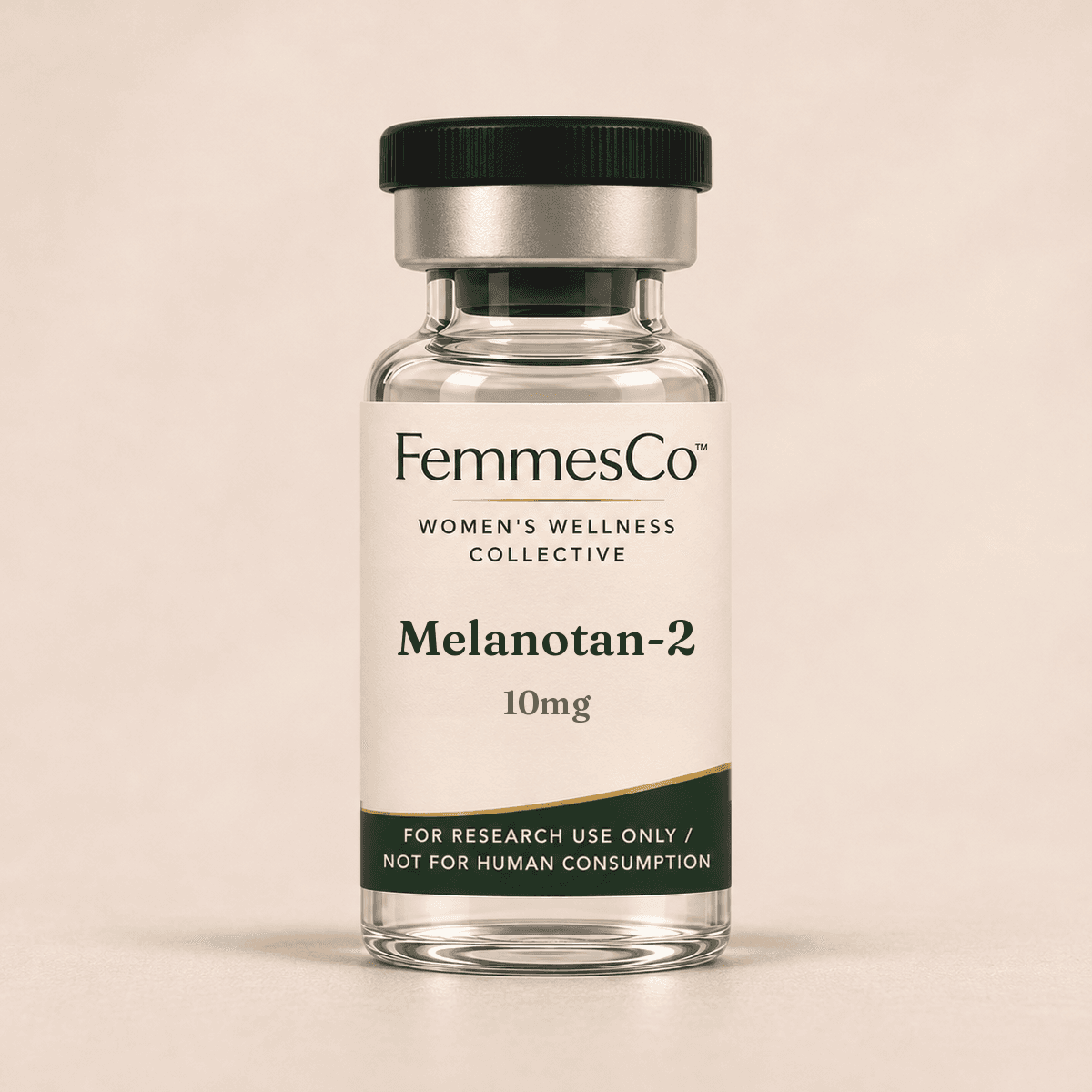
Melanotan-2
10mg · Single vial · Lyophilized powder
Dermatological research
Melanotan-2 is a synthetic analog of alpha-melanocyte stimulating hormone (α-MSH), used in melanocortin receptor pharmacology, pigmentation and photoprotection research.
- Studied in melanocyte stimulation and UV-protective melanogenesis research
- Referenced in women's melanocortin pathway research including dermatological and sexual response contexts
- Appears in melasma and hyperpigmentation research
Order
- Dose
- 10mg
- Pack size
- Single vial
- Form
- Lyophilized powder
- Storage
- 2–8°C
In vitro laboratory research use only · Not for human or veterinary use · Batch documented · Third-party tested · Ships from Canada
§ Research
Research · Melanotan-2
Overview
Melanotan-2 (MT-II) is a synthetic cyclic lactam analog of alpha-melanocyte-stimulating hormone (alpha-MSH), Ac-Nle-cyclo[Asp-His-D-Phe-Arg-Trp-Lys]-NH2. It was developed at the University of Arizona in the late 1980s and 1990s as a superpotent, protease-resistant melanotropin. The cyclic constraint and D-phenylalanine substitution increase receptor potency and stability relative to the native hormone. It is studied as a reference non-selective agonist in melanocortin receptor pharmacology. Its broad receptor profile distinguishes it from the linear, more MC1R-selective analog Melanotan-1, and it served as the structural precursor of later melanocortin agonists developed for other indications.
Mechanism of action
Acts as a non-selective agonist at melanocortin receptors MC1R, MC3R, MC4R, and MC5R, all G-protein-coupled receptors signaling through Gs and cAMP. MC1R activation on melanocytes stimulates eumelanin synthesis via microphthalmia-associated transcription factor and tyrosinase induction. Central MC3R and MC4R activation in hypothalamic and spinal circuits modulates energy homeostasis, food intake, and autonomic outputs, and is linked to the compound's effects on erectile function through oxytocinergic and nitric oxide pathways. The lactam bridge stabilizes the bioactive His-D-Phe-Arg-Trp conformation. Central effects persist after peripheral administration in rodents, indicating either blood-brain barrier penetration or action at circumventricular sites, and are blocked by melanocortin receptor antagonists such as SHU9119.
Key research findings
- 01
Structure-activity studies characterize receptor potency and selectivity across human melanocortin receptor subtypes, establishing it as a reference non-selective agonist.
- 02
Early-phase human studies characterized skin pigmentation endpoints alongside reported adverse effects including nausea and flushing.
- 03
Controlled clinical studies characterized erectile and sexual-motivation endpoints in male participants, informing later melanocortin agonist development.
- 04
Rodent studies characterize centrally mediated effects on food intake and adiposity through MC4R signaling.
Published references
Melanocortin receptor agonists, penile erection, and sexual motivation: human studies with Melanotan II
Effect of an alpha-melanocyte stimulating hormone analog on penile erection and sexual desire in men with organic erectile dysfunction
The information above is derived from published preclinical and clinical research. It is provided for educational purposes only and does not constitute medical advice, diagnosis, or treatment recommendations.